


Understanding FeNO
FeNO testing offers a fast and reliable way to assess inflammation in the airways. FeNO stands for fractional exhaled nitric oxide, a gas that the lungs naturally produce. When inflammation is present, particularly eosinophilic inflammation often linked with asthma, the level of nitric oxide in the breath becomes higher.
The test is simple to perform, non-invasive and suitable for both adults and children, making it a valuable tool in diagnosing asthma and supporting ongoing management in primary and secondary care settings.
This page outlines what FeNO measures, how the test works and how results are interpreted, helping patients and healthcare professionals understand the role of FeNO within today’s asthma care pathways.

FeNO Explained
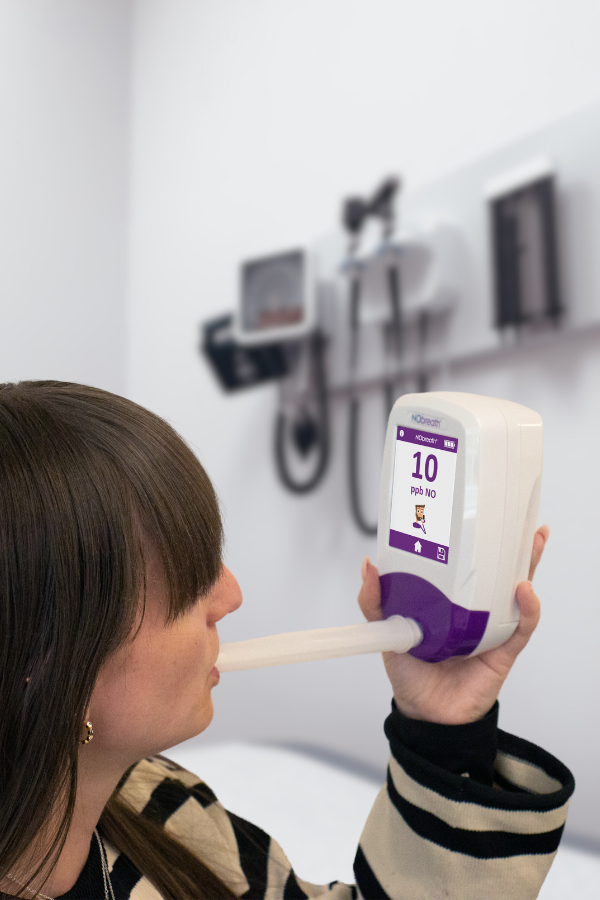
FeNO testing measures the level of nitric oxide present in exhaled breath. When the airways are inflamed, the body produces higher levels of this gas. During a FeNO test, the patient takes a deep breath in and then exhales steadily into a FeNO device, which provides a numerical reading within seconds.
A raised FeNO level can indicate eosinophilic airway inflammation, a type of inflammation commonly linked with asthma and one that often responds well to inhaled corticosteroids. For this reason, FeNO testing has become a valuable tool in supporting asthma diagnosis and guiding early treatment decisions.
The test is quick, straightforward and requires only the device itself, with no additional specialist equipment. This makes FeNO suitable for use in GP practices, community respiratory hubs and specialist asthma clinics across the UK.

What FeNO Levels Mean
FeNO test results are reported in parts per billion (ppb), and different readings can offer useful insight into what is happening in the airways.
Download our FeNO Interpretation Chart
Low FeNO
A low FeNO level indicates little or no eosinophilic inflammation. In these cases, asthma driven by this type of inflammation is less likely, or it may already be well managed with current treatment.
Intermediate FeNO
Intermediate readings should be interpreted alongside symptoms, medical history and inhaler technique. These results can suggest inflammation is present but not strongly active, and further assessment may be required.
High FeNO
A high FeNO level points to significant airway inflammation. This supports an asthma diagnosis and indicates that the patient is likely to benefit from inhaled corticosteroid treatment. Persistently high readings can also highlight poor disease control or potential issues with medication adherence.
Understanding FeNO levels helps clinicians make confident decisions around diagnosis, treatment plans and ongoing follow up.
FeNO for Asthma Diagnosis
Asthma can be challenging to diagnose because symptoms such as cough, breathlessness and wheezing are common in a number of other respiratory conditions. FeNO testing brings clarity by providing an objective measurement of airway inflammation, which is a key feature of asthma.
Raised FeNO results support an asthma diagnosis, particularly when combined with a patient’s medical history and lung function tests. FeNO is especially valuable when spirometry appears normal or when symptoms are inconsistent or difficult to interpret. The test helps clinicians determine whether inflammation is driving symptoms and whether inhaled corticosteroids are likely to be beneficial.
Incorporating FeNO early in the diagnostic pathway can reduce uncertainty, avoid unnecessary treatment trials and improve confidence in clinical decision making.
FeNO for Asthma Monitoring
FeNO testing is valuable not only for diagnosis but also for ongoing asthma management. Measuring FeNO levels over time gives clinicians a clearer picture of how active airway inflammation is and whether current treatment plans are effective.
Regular FeNO monitoring can:
• help identify poor asthma control at an early stage
• guide decisions around increasing or reducing inhaled corticosteroid doses
• uncover potential issues with medication adherence
• show how inflammation responds to treatment changes
• prevent unnecessary escalation of therapy when inflammation is already well controlled
By providing an objective measurement alongside symptoms and routine reviews, FeNO supports more personalised treatment decisions and helps patients stay on track with asthma management.
FeNO for Children
FeNO testing is suitable for children and young people and is often easier for them to complete than traditional lung function tests like spirometry. Because the test requires only a calm, steady breath rather than a forceful exhalation, it is a practical option in paediatric asthma pathways.
In children, FeNO can:
• confirm whether airway inflammation is present
• support early diagnosis when symptoms are variable or unclear
• guide decisions around inhaled corticosteroid treatment
• reduce the risk of both over-treatment and under-treatment
• help clinicians review asthma control during routine follow-up
Childhood asthma can be difficult to assess based on symptoms alone. FeNO provides a clear, objective measurement that helps clinicians ensure children receive safe, timely and appropriate treatment.

Talk to Our TeamTreatment
The benefits of FeNO testing
Minimal respiratory effort required
FeNO testing is well suited to young children and to adults who struggle with traditional lung function tests. Because it requires only a calm, steady breath rather than a forceful exhalation, it offers a simple and reliable way to assess airway inflammation without placing stress on the patient.
A FeNO test is easy to interpret
A FeNO test provides a single numerical reading expressed in parts per billion, supported by clear guidance on how to interpret the value. This allows clinicians to understand inflammation levels quickly and make confident, informed decisions during diagnosis and routine asthma reviews.
Treatment
response
FeNO testing works alongside other methods of assessing respiratory disease, including asthma, by showing how well a patient is responding to treatment. Changes in FeNO levels can help clinicians see whether inflammation is improving, staying the same or worsening.
Manage mis-diagnosis of asthma
FeNO testing supports more accurate asthma management by helping clinicians determine which patients do or do not require ongoing treatment. This reduces the risk of mis-diagnosis and ensures care is personalised to individual needs.7