


Understanding FeNO
FeNO testing provides a quick and reliable way to measure airway inflammation. FeNO stands for fractional exhaled nitric oxide, a natural gas produced in the lungs. Higher levels of nitric oxide can indicate eosinophilic inflammation which is commonly seen in asthma.
Because the test is simple, non invasive and suitable for adults and children, it has become an important part of asthma diagnosis and ongoing management across primary and secondary care.
This page explains what FeNO is, how it works and what different FeNO levels mean so that patients and clinicians can better understand the role of FeNO in modern asthma pathways.
Because the test is simple, non invasive and suitable for adults and children, it has become an important part of asthma diagnosis and ongoing management across primary and secondary care.
This page explains what FeNO is, how it works and what different FeNO levels mean so that patients and clinicians can better understand the role of FeNO in modern asthma pathways.

FeNO Explained
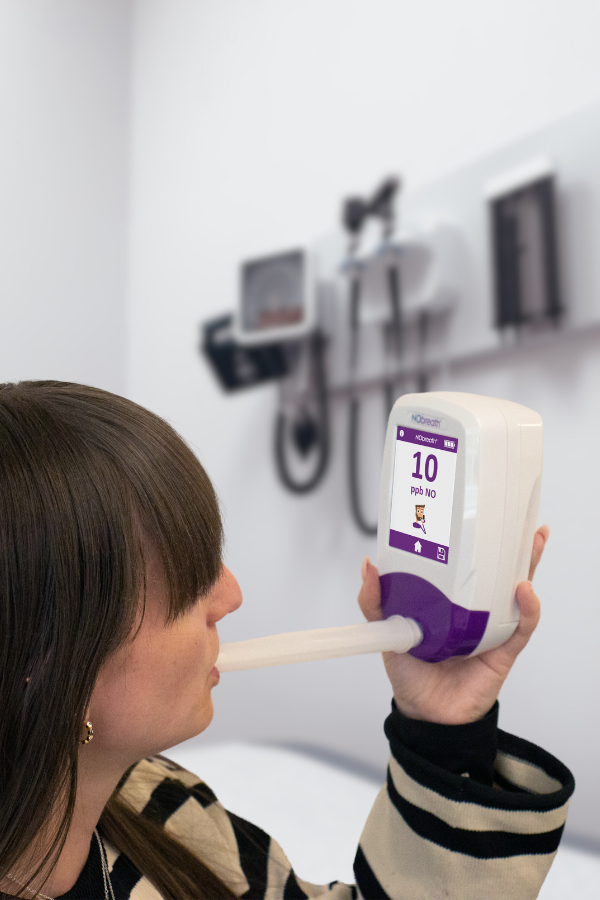
FeNO testing measures the amount of nitric oxide in the breath. When the airways are inflamed, the levels of nitric oxide increase. A FeNO test involves breathing in fully and then exhaling slowly into a FeNO device which gives a single numerical result in seconds.
A raised FeNO level can indicate eosinophilic airway inflammation, which often responds well to inhaled corticosteroid treatment. This makes FeNO especially useful in supporting asthma diagnosis and guiding early treatment decisions.
Because the test is quick, easy to perform and does not require specialist equipment outside of the device itself, it is ideal for use in GP surgeries, respiratory hubs and specialist clinics.

What FeNO Levels Mean
FeNO results are measured in parts per billion and different levels provide different clinical insights.
Download our FeNO Interpretation Chart
Low FeNO
A low FeNO level suggests there is little or no eosinophilic inflammation present. Asthma linked to this type of inflammation is less likely or may be well controlled with current treatment.
Intermediate FeNO
An intermediate level should be interpreted alongside symptoms, history and inhaler technique. Inflammation may be present but not strongly active.
High FeNO
A high FeNO level indicates significant airway inflammation. This supports a diagnosis of asthma and suggests the patient is likely to benefit from inhaled corticosteroids. High FeNO levels can also identify patients whose asthma is not well controlled or who may not be taking their medication as prescribed.
Understanding FeNO levels helps clinicians make clearer decisions regarding diagnosis, treatment and follow up.
FeNO for Asthma Diagnosis
Asthma can be challenging to diagnose because symptoms like cough, breathlessness and wheezing occur in many other conditions. FeNO adds clarity by providing an objective measure of airway inflammation which is an important feature of asthma.
Raised FeNO results support a diagnosis of asthma, particularly when used alongside history taking and lung function tests. FeNO is helpful when spirometry is normal or when symptoms are unclear. It allows clinicians to understand whether inflammation is contributing to symptoms and whether inhaled corticosteroids are likely to be effective.
Using FeNO early in the diagnostic process can reduce delays, prevent unnecessary treatments and improve confidence in clinical decisions.
FeNO for Asthma Monitoring
FeNO testing is not only useful for diagnosis but also for ongoing asthma management. Measuring FeNO over time helps clinicians understand how active inflammation is and whether treatment is working.
FeNO monitoring can
• identify poor asthma control early
• support decisions about adjusting inhaled corticosteroid doses
• highlight issues with medication adherence
• track how inflammation responds to treatment
• reduce unnecessary escalations in therapy
Regular FeNO measurements give a clearer picture of airway inflammation than symptoms alone and support more personalised asthma management.
FeNO for Children
FeNO testing is suitable for children and young people and is often easier for them than spirometry because it requires a gentle, steady breath rather than a forced manoeuvre. This makes FeNO particularly valuable in paediatric asthma pathways.
In children, FeNO can
• help confirm whether inflammation is present
• support early diagnosis when symptoms are unclear
• guide inhaled corticosteroid treatment
• reduce the risk of over or under treating asthma
• assist clinicians in reviewing asthma control during follow up
Because childhood asthma can be difficult to assess through symptoms alone, FeNO provides a clear and objective measure that supports safe and effective treatment.

Talk to Our TeamTreatment
The benefits of FeNO testing
Minimal respiratory effort required
FeNO testing is ideal for young children and for adults who are unable to perform spirometry. It provides a simple and reliable way to identify airway inflammation without the need for forceful breathing manoeuvres.
A FeNO test is easy to interpret
A FeNO reading provides a single value in parts per billion along with a clear interpretation guide. This helps clinicians make confident and informed decisions during asthma diagnosis and routine reviews.
Treatment
response
FeNO testing provides a complementary tool alongside other methods of assessing airway disease, including asthma, by helping clinicians evaluate how well a patient is responding to treatment.
Manage mis-diagnosis of asthma
FeNO testing helps clinicians identify patients who do or do not require ongoing treatment, supporting more accurate and personalised asthma management.7